From the journey to the goal
An agentic service does not follow a fixed path: it chooses its own steps, and every iteration is different.
From the Happy Path to the Happy Goal in agentic design
For years we designed journeys. With agentic services, the service designer delivers rules and data access, and the interaction changes at every iteration. The talk explained how to design a goal and how to measure whether it is reached.
You define a goal, hand over rules and access, and measure whether the goal is reached.
An agentic service does not follow a fixed path: it chooses its own steps, and every iteration is different.
The project becomes a set of rules, data access and stop conditions. The Happy Goal is the declared goal, together with the criterion that says when it has been reached.
The talk follows a real agentic service, step by step, and explains why this frontier belongs to service design and not to engineering.
«You no longer design a journey: you define a goal and measure whether it is reached.»Luigi Greco · from the talk abstract
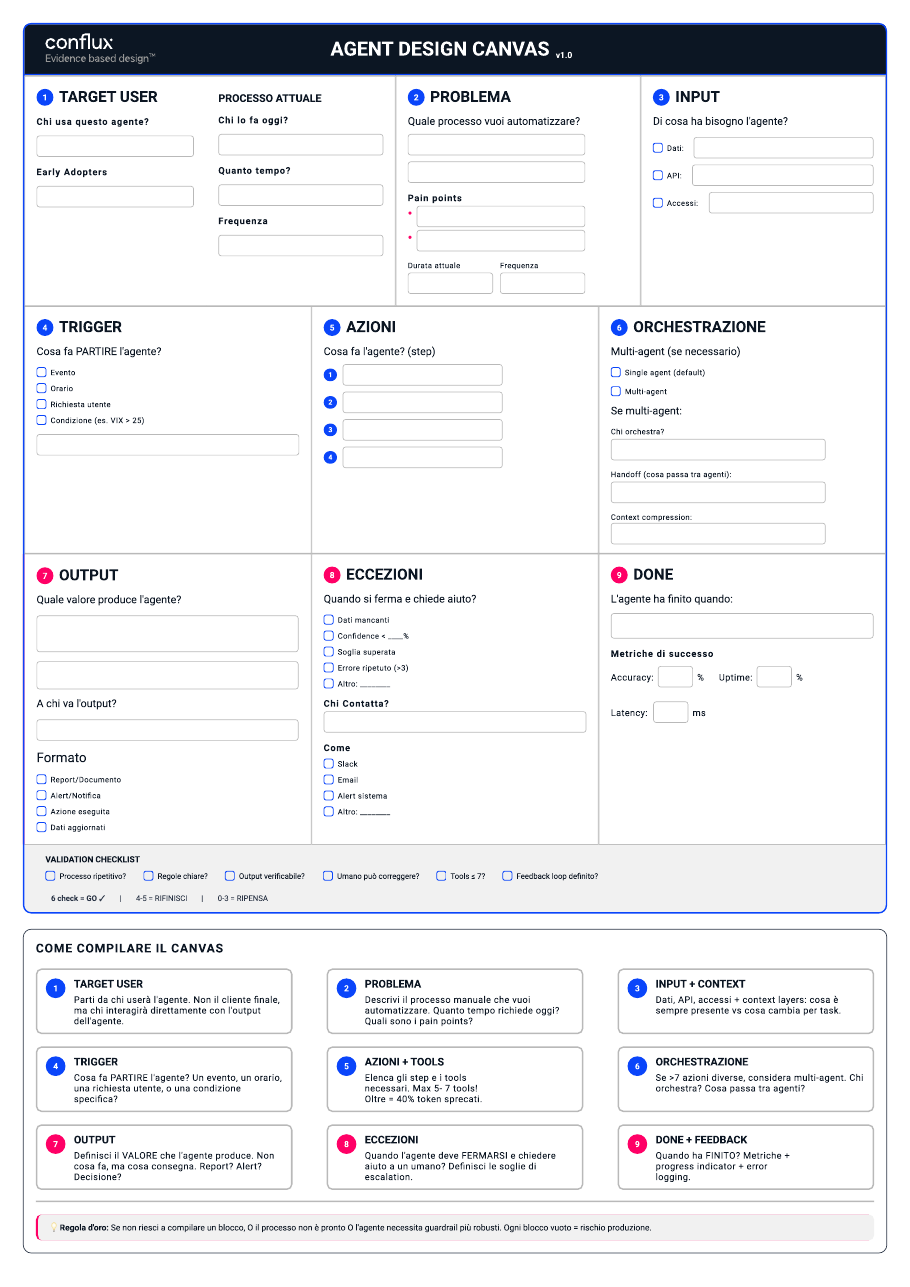
The Agentic Design Canvas, a method by Luigi Greco, lines up the decisions to take before writing code. Nine blocks: if one stays empty, the risk reaches production.
Who uses it, and how do they work today?
Which process are you automating, and what does it cost today?
Which data, APIs (Application Programming Interfaces) and access are needed?
What starts it: an event, a time, a request?
Which steps does it take?
One agent or several? Who coordinates?
What value does it produce, for whom, in what format?
When does it stop and ask a person for help?
When is the goal reached, and with which metrics?
The Happy Goal, in writingThe canvas ends with six validation questions. The number of positive answers tells you whether to start, refine or rethink.
Further reading: Agentic Design Canvas: designing agents before the code.
To decide what to build before deciding how.
To find the block that was left empty.
Product, design and engineering on the same sheet.
Two A4 PDFs, light and dark versions. To print and use with your team.
An A4 poster in nine blocks to design an agentic service before developing it.
No. The canvas collects product and design decisions, not code.
Product managers, designers and teams taking an agent from prototype to release.
Yes. It is designed to be filled in together, block by block.
Yes. We ask for your name, business email and role.
Let's talk about it in a Discovery Call.