How AI is changing UX design

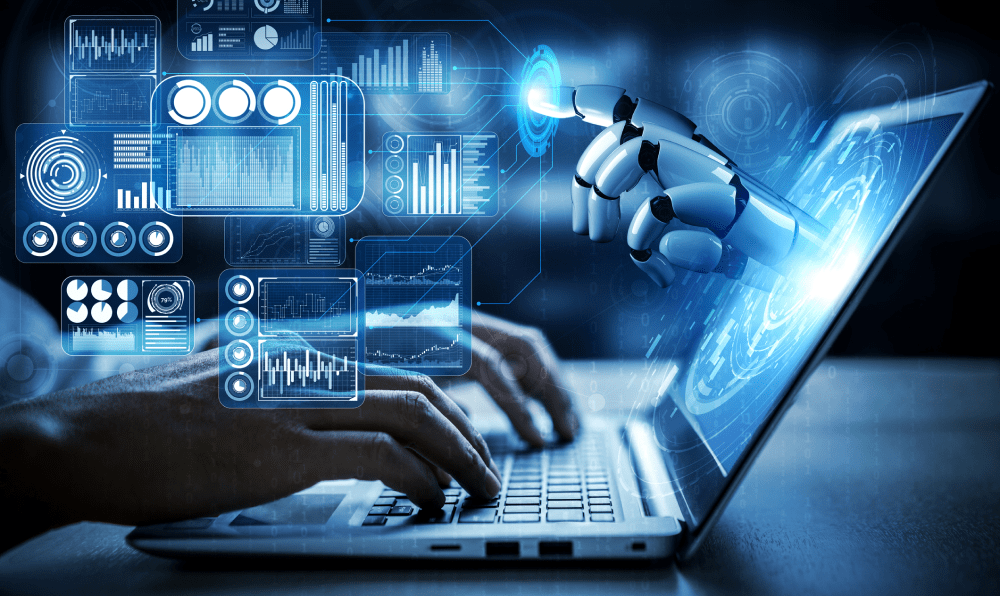


Artificial intelligence is becoming more and more important in how people and machines interact, and bringing it together with user experience (UX) design is now essential.
By “artificial intelligence” (AI) we mean sets of technologies that work together so that machines can perceive, understand, act and learn at a level comparable to human intelligence.
There is no single definition of AI, because it is not a single thing. The category includes, among others, technologies that deal with natural language processing (NLP).
The field also distinguishes two levels of artificial intelligence. The first, called narrow or “weak” AI, refers to applications or software that carry out a single task, or several closely related activities. Think of a weather app, or software that analyses simple data: the tools we use every day.
There are also cases of AI in which machines can take on more complex work, such as ChatGPT.
A general or “strong” form of artificial intelligence is not fully realised yet, which is why interaction between people and machines remains essential.
The benefits of artificial intelligence for user experience
The arrival of AI technologies has brought significant change in every sector and every kind of work. On one side, the potential of AI has changed operations and procedures inside companies. On the other, the way customers make decisions has changed.
In the mechanical era, technology was built as an extension of the human body, in a spatial sense. Today, technology and artificial intelligence are a support on the cognitive and design plane.
User experience is evolving quickly, and artificial intelligence is one of the technologies with a growing impact (an influence that is likely to keep growing).
User experience designers and user experience researchers can gain a great deal from AI systems that make it possible to:
- Make it easier to collect data on the people who use a product;
- Automate some parts of the design process, freeing people for more complex work;
- Offer greater personalisation, so that the person at the end of the chain receives content closely tailored to their needs and interests;
- Give people a better customer service experience, able to solve problems quickly and well. This matters a great deal in e-commerce, where a chatbot supported by AI can improve the user experience substantially.
“The arrival of AI technologies has brought significant change in every sector and every kind of work.”
Artificial intelligence and user experience in a human-centered view
AI technologies and user experience design share a purpose: to understand human behaviour in order to make digital products easier to use.
The shared goal is to make interaction with products and services human-centered. In the past, the people who built technologies and user interfaces often focused on delivering innovative technical capability, useful for reaching business goals quickly, and then arranging it in an attractive graphical interface. The result was products and services handed down to the people who were meant to use them, who sometimes used them little or not at all, wasting the designers’ work.
The human-centered approach, also called user-centered design, aims to involve the person who will use the product from the earliest stages of development, so that the product is easier to use and the experience is more pleasant and engaging. The use of AI technologies should therefore serve a single purpose: to improve human activity and meet human needs as well as possible.
Conclusions
The end goal of artificial intelligence is to raise the productivity and effectiveness of any product or service. Designers, for their part, can bring AI into the design process in order to reach a steadily higher level of customer satisfaction: used well, it can be a genuine help in developing and running services for customers.
In short, the uses of AI in user experience design will grow considerably. At the same time, in the current state of the art, artificial intelligence cannot replace a user experience or user interface (UI) designer, or a researcher, in the design of a digital service or product.
We also recommend