Is investing in user experience worth it?



How to calculate the economic return of a better user experience
Some years ago — back in 2001 — IBM published a well-known paper on the cost of usability, trying to explain the value of investing in software that is easier to use: “Every dollar spent on ease of use returns between 10 and 100 dollars” was the summary, effective and a little rough. Over the years, other research has reinforced the same point: weaknesses in user experience cost companies in productivity and revenue, and investing in a redesign of the products people use is worth the outlay.
Measuring the return on investment in user experience (UX) is essential if you want to assess the economic impact of an inefficient system and the benefits of making it easier to use. So how do you calculate the return on investment (ROI) of research and design for user experience?
The right metric is the one that answers the right question
Every redesign has an impact. The most immediate, and still not to be ignored, is how much people like the result: satisfaction, after all, is one of the founding dimensions of usability. Too often, though, the judgement stops there and ignores performance: how efficient and effective is the new system? How much time does it save in getting the work done? How much money does it save? And how much does it help you earn?
The calculation of return on investment for user experience should always consider which aspect of system performance improves when the experience is optimised.
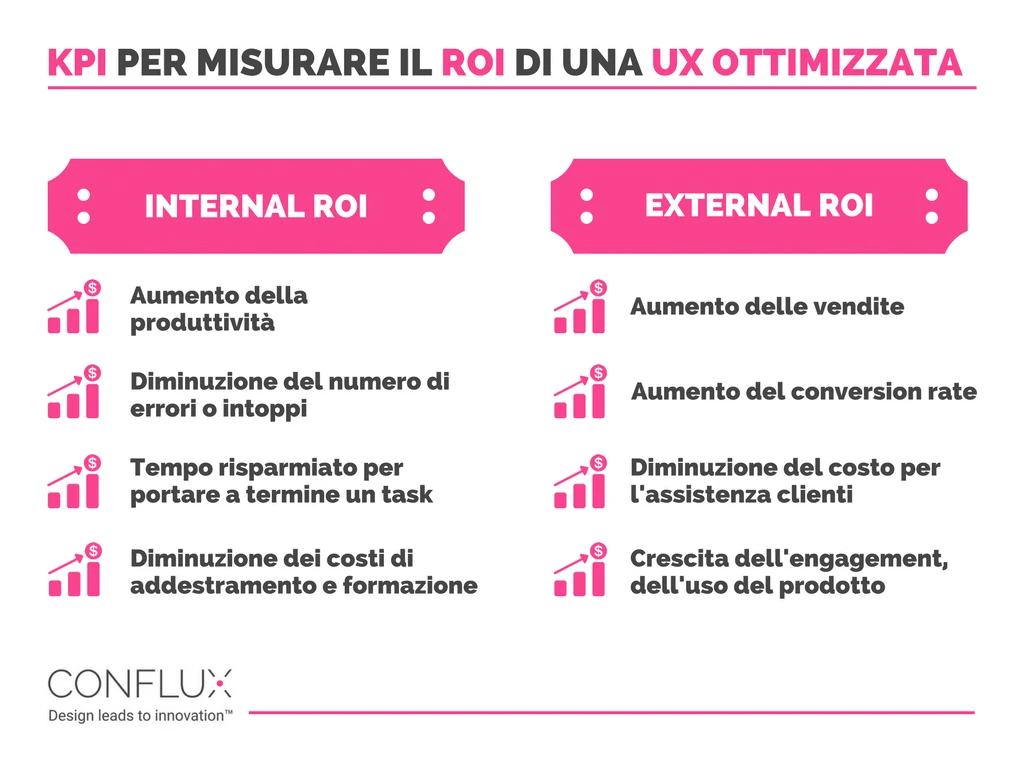
Return on investment, in short, is a numerical ratio that measures the yield of the investments you have made. The calculation of return on investment for user experience should always consider which aspect of system performance improves when the experience is optimised. It is essential to ask the right question and to choose the most suitable key performance indicators (KPIs) to assess the impact of changes to an interface, to the system in use, or to the organisation as a whole. A redesign can affect the internal workings of a company (in this case we speak of internal return on investment) or its business (external return on investment). Let us look at a few practical examples.
Measuring the impact on a company’s internal efficiency: internal return on investment
Usability shortcomings in the products or procedures used inside a company have a direct consequence in time lost and money spent. Improving user experience inside an organisation means acting on its efficiency. And efficiency is measurable. How? By looking at the aspects that an improved experience actually changes, for example:
- the time it takes to complete a task
- the number of errors made
- the number of requests for support
- the hours spent on training.
These metrics, which essentially measure the time spent on an operation, are only the starting point for measuring the “before” and “after” of a user experience redesign. Other parameters also need to be taken into account: the number of people who use the system, their salary, and how long the new experience is expected to remain in use. To arrive at the return on investment, the product of these values is then compared with the development cost of the new solution that improved the experience for employees.
Measuring the impact on the business: external return on investment
Improving the usability of a product aimed at the public has clear implications for sales performance and, more generally, for the business. For so-called external return on investment, too, you can assess the impact with different metrics, depending on what you want to measure:
- an increase in the number of sales
- an increase in the conversion rate (or a decrease in the abandonment rate)
- an increase in the average value of a sale
- a decrease in the cost of customer support
- growth in the use of the product
- a change in the number of loyal visitors
- a change in the Net Promoter Score (NPS).
Here too you then need to weigh the monetary value of these changes in business key performance indicators. Raising the conversion rate through better user experience work brings economic advantages that are readily quantified: there are also useful tools that help automate this calculation.
We also recommend