Artificial intelligence and human-centered design



Artificial intelligence (AI) promises to transform radically the way we live and work. But the real revolution does not lie only in the power of this technology, but in the experience it offers to the people who use it. An optimised user experience (UX) is the key to unlocking the full potential of AI, turning complex technologies into intuitive and accessible solutions. So it is not only a matter of what AI can do, but of how people interact with it.
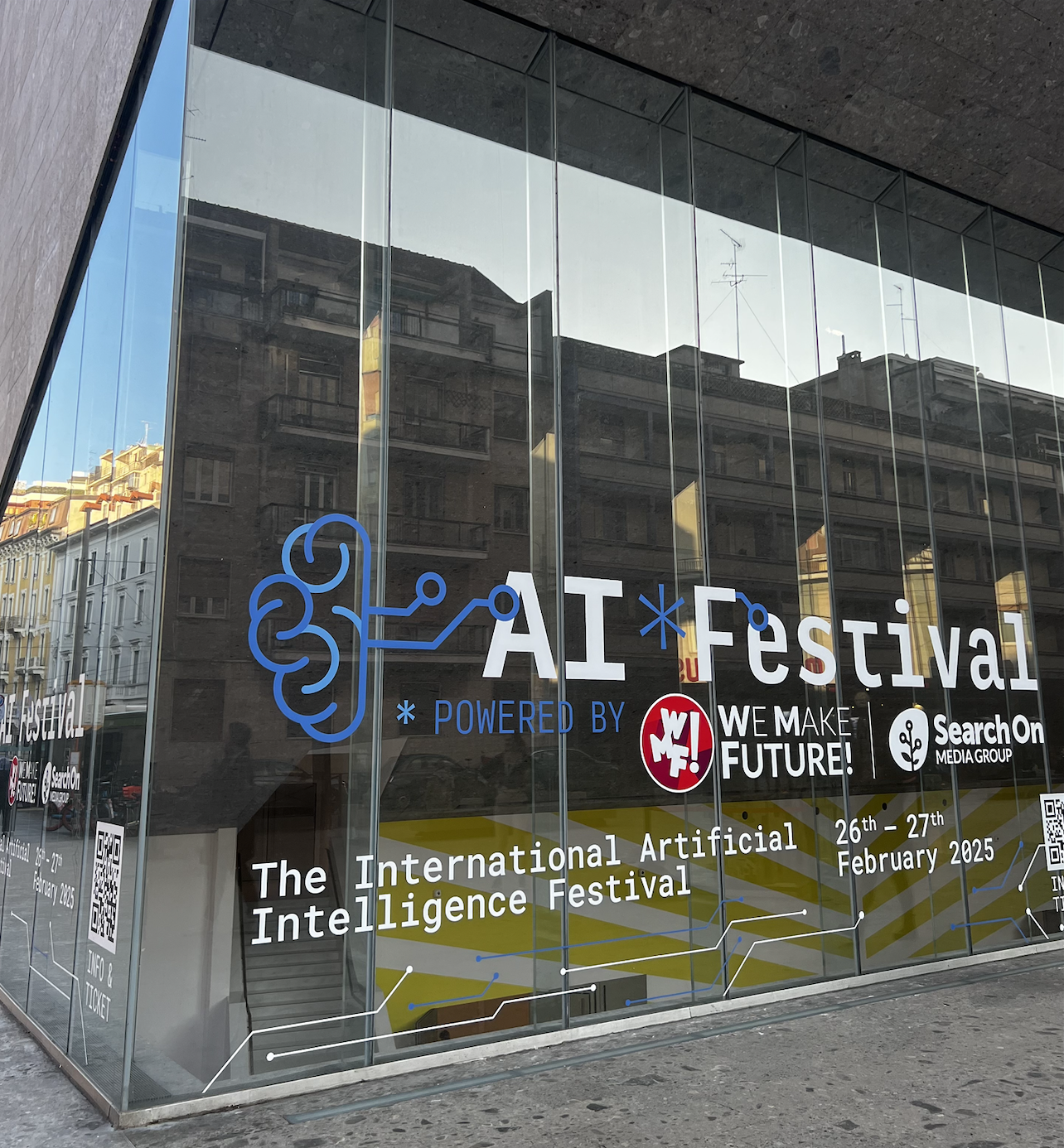
As a user experience agency, we took part in the AI Festival and saw at first hand how people-centered user experience design is fundamental to the success of any product or service based on AI.
In this article we will explore the pairing of AI and user experience, and show why a well-designed user experience is the secret ingredient for a wide and successful adoption of artificial intelligence.
AI Festival: human experience at the centre of innovation
Our recent participation in the AI Festival allowed us to explore new perspectives, and also to confirm some observations on the relationship between artificial intelligence and user experience. The focus of the event was the integration of AI into company processes, into work, and also into everyday life. There was talk of technology, then, but also a great deal of talk about people.
The discussions brought out the need to balance the power of AI with human-centered design, creating meaningful interactions and building trust.
It emerged clearly that it is the experience people have with this technology that determines whether these innovations will be adopted or not. This opportunity for discussion on the subject therefore strengthened our conviction that user research and user experience design are precisely the bridge between the potential of AI and its positive impact on people’s lives.
User experience as a key element for the success of AI
The success of any product or service based on AI is closely tied to the quality of its user experience. Even the most sophisticated model risks failing if people cannot understand it or use it effectively. So one can say that its adoption does not depend only on the technical capabilities it possesses, but above all on its ability to fit fluidly into people’s existing workflows and to integrate into their everyday life.
If interaction with an AI system is complex, frustrating or unintuitive, people are unlikely to adopt it, regardless of its potential.
In a context in which AI models are becoming more and more advanced and their capabilities tend to converge, user experience will become the differentiating element among AI products with similar functions.
Investing in user experience design is not an option, but a strategic necessity for companies that are betting on AI: an effective user experience translates into greater involvement of the people who use the product and a significant return on the investment.
Only a human-centered user experience, which considers the context of use, emotional needs and social interactions, can guarantee the success of AI.
Critical factors for the adoption of AI: accessibility, usability and trust
An intuitive and accessible user interface is fundamental to making AI more understandable and usable for everyone, reducing the sense of complexity that often accompanies these technologies. A people-centered user experience design removes obstacles, making AI not only usable by more people, but also pleasant to use.
Look at ChatGPT: its simple interface made a complex AI system accessible to millions of people, making the interaction feel natural.
Another fundamental aspect is the creation of native experiences for the person, integrating AI harmoniously into existing workflows. The success of tools such as GitHub Copilot is an example: integration into the development environment familiar to programmers favoured rapid adoption. The result is an AI that assists, without imposing new ways of working.
A user experience that promotes transparency and generates trust in AI
To gain people’s trust in artificial intelligence, the user experience must aim at transparency. Making the decision-making processes of AI clear, and the way it uses data, is essential. Explaining the why and the how of the conclusions proposed, together with their degree of reliability, allows people to understand the system and to feel a greater sense of safety in using it. This transparent approach is the antidote to the ‘black box’ effect that often characterises AI.
The importance of conversational design for chatbots and virtual assistants
Conversational design is fundamental for chatbots and virtual assistants. The aim is to create interactions that are fluid, natural and human. The ability of an AI system to communicate effectively is now considered essential to its success.
What we are seeing is a transformation from traditional systems with coded commands to AI-based interfaces, able to understand natural language and provide empathetic responses. AI agents, based on generative AI, work to respond to customers’ requests with greater effectiveness and empathy, radically improving the customer experience.
It is also fundamental to define the tone of voice and the personality of the AI, in order to create systems that are reliable and with which people can relate easily. User experience research, in this context, helps to identify people’s expectations: an AI assistant in a medical setting, for example, will require a different tone from one designed for entertainment.
Differentiating an AI product with user experience
As AI models improve, competition will no longer be based only on the technical capabilities of an AI product, but rather on the user experience, which will become an essential differentiating factor.
In this, user experience research and design are fundamental activities for designing the interaction with artificial intelligence tools, creating unique experiences that will make people prefer one AI solution to a competing one.
- Understand people thoroughly — A successful user experience is based on a deep knowledge of the people who will use the product. In-depth research (interviews, data analysis, usability tests) is fundamental to identifying needs, behaviours and expectations.
- Design unique experiences — The complexity of AI must be translated into simple, intuitive and engaging interactions. This means going beyond functionality, creating experiences that are pleasant and without friction.
- Build trust — Transparency is essential. Making AI understandable, explaining how it works and why it takes certain decisions, removes distrust and favours adoption.
- Measure and optimise — User experience design is not a static process. Testing the experience with real people and iterating the design on the basis of feedback is important to maximise the impact and the success of the product.
Investing in a high-quality user experience, then, means transforming AI from a simple technology into a successful solution: a product that not only works, but that is adopted and appreciated by the people who use it.
The other side of the coin: the future of user experience in AI
Artificial intelligence is not only one of the fields in which user experience design can make a contribution. The sector of user experience design itself is being transformed thanks to the integration of AI into workflows and into the solutions designed.
Here are the main advantages:
- Rapid prototyping — Tools based on AI accelerate the creation of information architectures and interface designs, starting from simple prompts in natural language. This allows designers to test and refine different ideas quickly.
- Rapid analysis of data — AI algorithms analyse in a few minutes large quantities of qualitative data, such as interview transcripts, identifying themes, emotions and people’s needs.
- In-depth insights — AI reveals nuances and trends that might otherwise escape human analysis.
- Synthetic users — User personas generated by an AI, which you can ask questions in order to explore a problem, conduct interviews and obtain simulated feedback.
- Personalisation of the experience — AI adapts the interface and the user experience on the basis of the data collected on the behaviour of that specific person.
-
Continuing to explore the new frontier of AI and user experience
Artificial intelligence and user experience are an indispensable pairing. The technological innovation of AI must be accompanied by a deep understanding of people’s needs, in order to make it easier to use and to integrate it effectively into workflows and into people’s everyday reality.
As a user experience agency specialised in the integration of AI, we believe strongly in the need to put the person at the centre of every process of designing AI products and services. At the same time, we explore the potential of AI to improve user experience research and design.
The relationship between user experience and AI will continue to evolve. Our task is to continue to explore and define the best practices for an ever more effective and human-centered integration.
We also recommend