Physical and digital design in Milan


During Milan Design Week 2025, the line between physical objects and digital components is getting thinner. That is why it matters for brands to design experiences that are coherent, useful and multisensory.
Bringing physical and digital together is no longer optional
Anyone who has visited Milan Design Week at least once knows that it is not only about aesthetics or trends: it is a vast, distributed laboratory where objects, materials and spaces tell stories, stir emotions and, more and more, connect to digital services and technologies.
This 2025 edition, dedicated to the theme “Connected Worlds”, has made one fact clearer than ever: design today can no longer live in separate compartments. You need to design objects and services with every touchpoint in mind, physical and digital, or, better still, design hybrid experiences that move through these two worlds without a break.
User experience lives on more than one level
Affordances and visual consistency
When a physical product has a digital extension — an app, a web interface or a support platform — these parts need to speak the same language. Affordances should be clear and consistent: what is intuitive in the physical world should remain so in the digital one, and vice versa.
This is not only a matter of aesthetics, but of cognitive fluency: the fewer the points of friction, the more at ease people feel, and the more quickly they understand how to interact.
Distributed interactions
An object today can be touch-based, but also smart, able to speak, connected and fitted with sensors. It can interact with people in ways that go beyond simple manual use: it can send a notification, be controlled from a phone, and update its behaviour on the basis of data. That is why it is important to think of interaction as distributed, across several channels and contexts, which today more than ever are tied to hybrid design practice.
What we are seeing at Design Week 2025: a few examples
24 HOURS by Riviera
Curated by Jamie Wolfond and Simple Flair, the 24 HOURS project gathered 24 clocks designed by international designers. More than tools for measuring time, these objects became narrative devices: they evoke memories, convey emotions and question our perception of technology.
The link with the digital is not always explicit, but it lives in the idea of experiential time, which today also runs through tools that bring together apps, notifications, and visual and acoustic feedback.
Curious X: Sensorium Piazza
Inside Tortona Rocks, the Sensorium Piazza installation turned an urban space into a multisensory and interactive environment. Thanks to a digital canvas in continuous change, the space reacts to people’s movements, to their interactions, even to sound.
It is not a product, but a powerful example of how physical design can be only one part of the story, completed by a digital dimension that is not an accessory, but fundamental to the experience.
Designing hybrid experiences
For product teams, designers and strategists, all of this has a very clear consequence: it is no longer enough to think in terms of an interface or an object. You need a view of the whole.
Map every moment of use
A physical object might have an informative landing page, an app for configuration, a tutorial on YouTube, a support channel through a chatbot. All of these are moments of interaction, and they need to be designed with care and consistency. The design of the experience is distributed across ecosystems, not single solutions.
Simplify without oversimplifying
A well-designed system is one in which people do not notice the transitions, but always feel guided. Simplicity is not minimalism, but complexity made harmonious, where every part has a precise function. This is especially important in physical-digital products, where the risk is that the digital part is only an afterthought, poorly cared for or hard to use.
Conflux: when the meeting of physical and digital runs through data
In our day-to-day work, too, we see how important it is to design experiences that are coherent and fluid between the physical world and the digital one. It is not only a matter of making an interface “usable” or a product “beautiful”: it is a matter of understanding how people actually live the experience of a brand, moving through different touchpoints, environments and devices.
That is why we always put research, observation and the analysis of behaviour at the centre. Only in this way is it possible to design meaningful and sustainable interactions, able to adapt to what people really need.
User experience analysis: between physical and digital stories
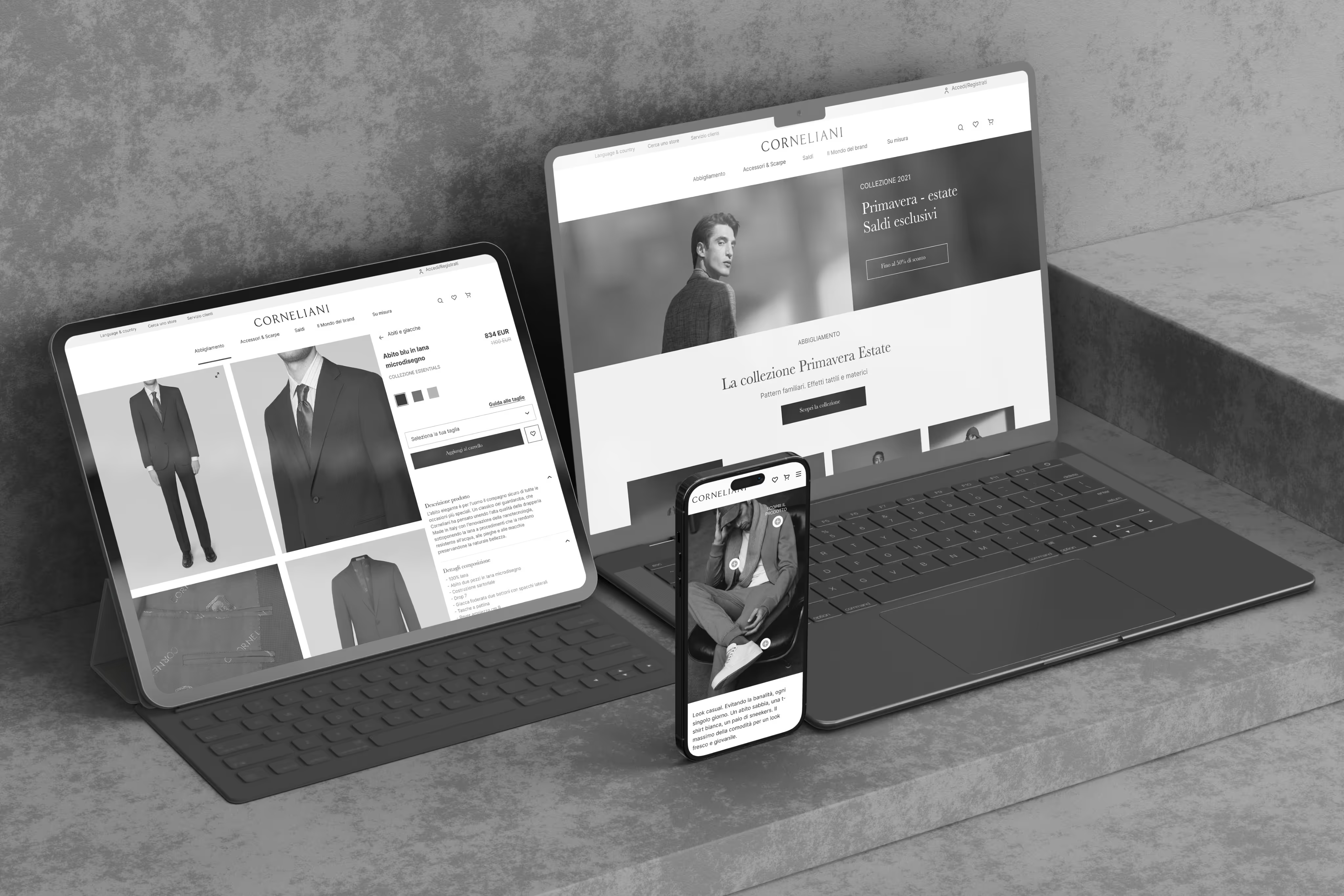
One of the projects that best illustrates our approach is in fashion. It involved the introduction of a new business-to-consumer (B2C) app, conceived to accompany customers both in online shopping and during a visit to the store. We carried out an in-depth analysis of the user experience to identify potential issues in the real use of the application, in both contexts.
Using shadowing and digital ethnography we were able to observe people’s spontaneous behaviour, and through a focus group we understood how the customer journey was changed by the introduction of the app.
This allowed us not only to highlight specific interface problems, but also to map points of friction and opportunities along the whole of the person’s path, online and in the store. The evidence we gathered was essential to refine the launch phase, to understand which features were genuinely a priority, and which paths of evolution mattered most for different kinds of users.
Working on projects like this confirms, every time, how strategic it is to think in a systemic way: an app does not live on its own, but is part of an ecosystem that includes stores, staff, communities and distributed processes. And only by studying these environments as a whole can we truly design meaningful experiences.
A physical-digital ecosystem for a loyalty programme
In beauty and wellness, instead, we supported a brand in a complete rethink of its loyalty programme, with the aim of creating a coherent experience between the physical store and the digital platforms.
The project grew from the need to make the service consistent across the different regions in which the company operates, while also improving the quality of the user experience. After a comparative analysis of the main loyalty programmes in the sector, the work concentrated on a series of collaborative workshops with stakeholders, useful for clarifying business goals and design priorities. Design then covered both the responsive website and the mobile app, which were tested with people in the target audience to gather concrete feedback and refine the design.
Here too, the central point was not simply to “put a service online”, but to create continuity between the experiences lived in the store and those online, valuing the specific character of each channel and supporting use without interruptions.
In conclusion
Milan Design Week has shown us that physical design and digital design are no longer separate entities. Today we talk about connected experiences, of objects that tell their story on more than one level, and of interactions that need to be conceived in a coherent, inclusive and sensitive way.
This view calls for a new design awareness, in which designers, user experience researchers and strategists work together to build ecosystems of meaning, not only products.
We also recommend